- Lift, divide and replant irises (last chance this year)
- Continue weeding; apply Killex or other product, if desired, to kill weeds
- Deadhead annuals for continued bloom; deadhead some perennials to continue bloom but leave some seedheads for decorative effect through the winter
- Continue regular watering
01 September 2010
September To Do List
The September "To Do List" has been posted in the Garden Calendar. Here is a portion of what you will find there:


30 August 2010
I'm in Love: Pink Diamond Hydrangea

Hydrangea paniculata 'Pink Diamond'


As the panicle flower of the Pink Diamond Hydrangea matures, it takes on hues of pink and dusty rose. I expect that will happen here the end of August or beginning of September. Here's a photo of mature blooms taken last year.

This photo was taken during the late evening. When I first saw this hydrangea come into the greenhouse, I was in love. There's a romantic essence to hydrangeas, especially paniculatas and lace-capped. Though, I'm sure, many will say the mopheads rival my favorites for romanticism.
25 August 2010


24 August 2010
Spotlight on Ohio Buckeye

photo by Barry V.
Average Height - 20-40 feet (some specimens have grown up to 48 feet)
Average Canopy Width - 25-30 feet wide (oval to rounded and dense)
Leaf - Palmate compound leaflet of typically 5 leaves (rarely 7)
Flowers - light yellow/green-yellow upright panicles in the spring
Fruit - nuts encased in a 1-2 inch prickly husk - not edible (squirrels like them)
Fall Colour - yellow-orange sometimes red (Autumn Splendor Buckeye has red-purple fall foliage)
Bark - Grey furrowed
Root - forms a tap root
Growth rate - develops tap root its first year. Following years significant growth is noted. May be considered a medium/fast grower (up to a foot/year) but not so fast as a poplar.


The Ohio Buckeye makes an attractive shade tree, preferring a soil Ph of 5.0 - 7.5. The tree prefers a moist loam and is subject to leaf scorch if it dries out. Not drought resistant. In its natural habitat it is an understory tree growing along river banks and creek beds.
It has no major insect problems but may be susceptible to powdery mildew and leaf scorch.
It is not widely known as a speciman tree in our area though it is gaining popularity. As it is medium size at maturity it readily fits into most urban landscapes and offers beautiful fall colour. If you have no room for a maple but still want impact in the fall, select an Ohio Buckeye.
Hardy to zone 3.

photo by Barry V.
http://www.na.fs.fed.us/spfo/pubs/silvics_manual/volume_2/aesculus/glabra.htm

Photo by Barry V.

Many thanks to Barry for the photos of his Ohio Buckeye
23 August 2010
Alberta Invasive Plants Council

http://www.invasiveplants.ab.ca/management.html
Check the above link for a list of noxious and prohibited noxious weeds for our province.
Himalayan Balsam

this plant was seen growing in someone's yard with more small plants nearby
Himalayan balsam:
- grows in moist conditions and is commonly found along river banks, stream beds and creeks
- stems are red in colour
- leaves are dark green and lance shaped with jagged edges
- flowers are shaped somewhat like a snapdragon and vary in colour from pink to purple and sometimes white
- flowers summer through fall from June to October
- can grow up to 2 metres high and sometimes 3 metres high (though rarely)
- Himalayan Balsam is an annual
- each plant produces between 700-800 seeds
- seed pods are explosive and can throw seeds over 6 metres away from the original plant.


Species/ Impatiens glandulifera
Common Names/ Policeman’s Helmet, Indian Balsam
Sometimes known as Himalayan Impatiens
http://www.invasiveplants.ab.ca/Downloads/FS-HimalayanBalsam.pdf
22 August 2010
In the Spotlight - Bee Balm

Native to North America, bee balm is a hardy highly scented plant. Even the leaves are scented. Bee Balm's scientific name is owed to Nicolas Monardes, a Spanish physician and botanist who chronicled American flora in the 16th century. The name Bergamot is derived from the bergamot orange to which it smells similar.
Fast growing, Bee Balm grows in clump form and is best suited to full sun to part shade locations with moist well-drained soil. Its average size at maturity is 2-3 feet high and wide, depending on the variety.
True to its name, Bee Balm attracts bees as well as hummingbirds and butterflies. The clump should be divided every three years to keep its spread under control. Prune back in the fall and feed with an all-purpose fertilizer (if desired) in the spring such as 20-20-20.
Like most plants, under adverse conditions like cool humid days, warm days and cool nights, Bee Balm can be susceptible to powdery mildew. Plant where it gets good air circulation. Treat with a sulphur spray, spraying the foliage well but being careful not to overdo it as the sulphur also kills beneficial bacteria in the soil. Remove badly mildewed leaves and destroy them.
Hardiness Zones: 4,5,6,7,8,9 (zone 3 - may need to mulch in the fall)
In the Spotlight - Mock Orange

Galahad Mock Orange
MOCK ORANGE SHRUB (PHILADELPHUS)
If only a picture could capture the fragrance of a Mock Orange in bloom! The flowers are similar to that of an orange or lemon tree and the fragrance like an orange or, as one of my children said, cotton candy. In our area, the mock orange blooms June/July. It is lovely to sit out in the yard on a warm summer evening and catch a whiff of fragrance of mock orange in the night. The white blossoms glow in the twilight, reflecting whatever light is nearby. Truly one shrub I do not want to be without.
There are several varieties of Philadelphus (mock orange) hardy for our area, zone 3. Waterton, Minnesota Snowflake, Galahad, Golden, Miniature Snowflake, to name a few. I purchased Galahad about 3-4 years ago and wish I had more.
Though unimpressive the remainder of the season, when in bloom it draws compliments from everyone! The Galahad grows about 4 feet tall and wide. I don't fertilize, though one could give it a dose with rose fertilizer early spring. Prune only after it has completed flowering, and directly afterwards not late summer or fall and definitely not early spring or it will not bloom!
The fragrance varies by variety, so shop for them while they are in bloom. The flowers range by variety from single, like the Galahad, to semi-double to fully double from an inch to 2 inches across on some varieties.

Galahad Mock Orange
USES IN THE LANDSCAPE
Mock orange may be grown as a specimen plant, a focus in the border; as a foundation shrub; or grow a grouping as a hedge. It tends to grow somewhat vase-shaped, but clipping can encourage the plant to fill out and become dense.
LOCATION FOR PLANTING
This plant does well in full sun or even part sun and shade. Some have had luck growing it in a rather shady location. Avoid planting near a reflective surface or white siding or fence where the sun will reflect onto the foliage and flowers and fade them quickly. The mock orange prefers a well-drained soil, but isn't too particular about the type of soil. However, a sandy loam type soil that is well-drained would be ideal. The mock orange is an easy care plant. Not demanding too much attention, except to exclaim over its beauty and fragrance!
PRUNING
Prune only after flowering. After its second year in your garden, you may desire to remove some of the older branches which no longer produce blooms. Remember the rule of thumb, never more than 1/3 of the overall plant should be pruned in a year.
21 August 2010
Picture This Photo Contest
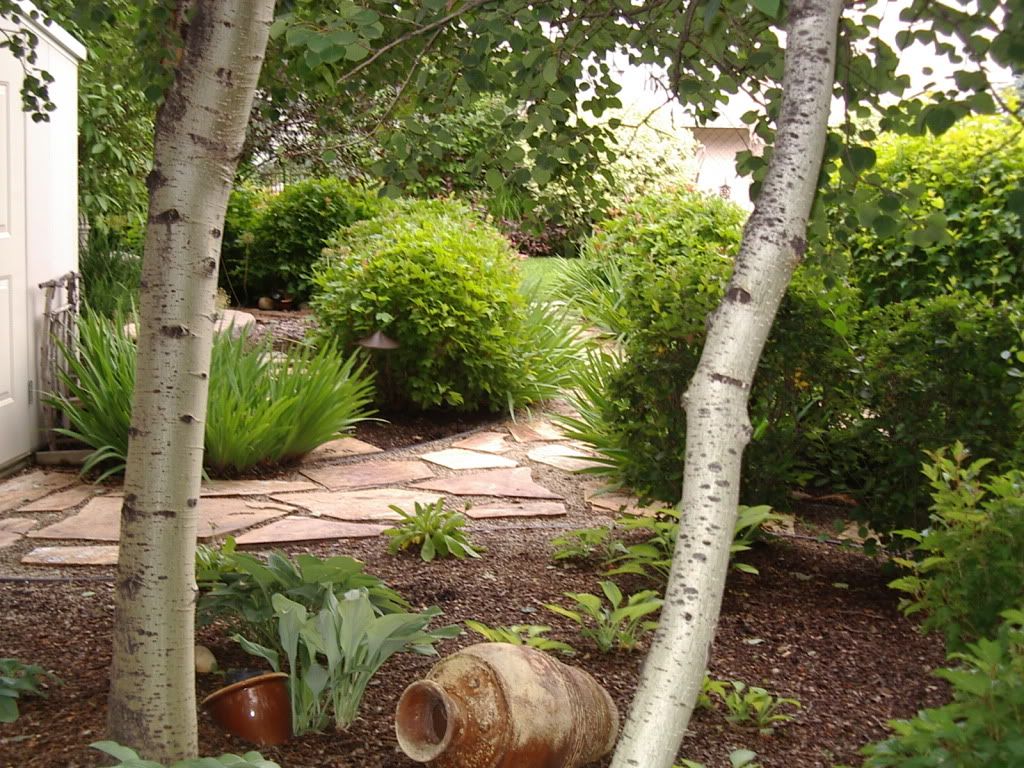
Every time I walk by this yard which backs onto the local ravine, I have to pause. I peruse the landscape, taking in the path, the shrubs and perennials. The path meanders through the shrubbery to a bird bath, or another turn takes you to a bench and yet another brings you to a fire pit. I marvel at the twists and turns and the beauty of this well-kept haven. So, this is the photo I have chosen to enter in August's Picture This Photo Contest "On the Road Again".
The contest is here should anyone like to join us:
http://www.gardeninggonewild.com/?p=13097&cpage=1#comment-15621
Subscribe to:
Posts (Atom)
LinkWithin
