Showing posts with label Japanese Gardens. Show all posts
Showing posts with label Japanese Gardens. Show all posts
01 August 2016


14 September 2015
Find Serenity at the Nitobe Memoirial Garden
 The Nitobe Memorial Garden is located in the forest at the edge of Vancouver, British Columbia. A spectacular portion of the UBC landscape, the Nitobe Memorial Garden was designed as a memorial to Inazo Nitobe, a Japanese diplomat and politician also known for his written work and teachings. Nitobe's goal was to "become a bridge across the Pacific." The garden lies on two and a half acres of land. Its landscape was designed and constructed by landscape architects and gardeners with recommendation from the Japanese government.
  Each component is in harmony, placed with deliberation and maintained with the utmost attention to detail. Several of the plants including some maples, cherry trees, azaleas and irises were imported from Japan. Waterfalls, streams, the gazing pond, the plants and every stone are representative of nature. Several lanterns accent the property, including a Nitobe lantern that was erected by friends of Inazo Nitobe.
As you enter the garden, to your left is Ichibō-an, the tea house which is surrounded by a roji tea garden and an inner garden. To your right is a path that encircles the gazing pond which is the central focus of the garden. There are tours that are highly recommended to take, specifically during spring cherry blossom, summer for the irises, and autumn for the splendour of the colouring of the maples. I went in August and it was just as luxurious but I'd love to come back in spring and again in the autumn.


The garden is designed to suggest a passing of time: hours, days, seasons, years. One could easily spend hours here at a time. It is the perfect place for personal reflection and meditation. It is serenity, peace, and breathless beauty all in one location.


I hope you enjoy the photos here. May they entice you to plan a visit to the garden soon.


We saw Edgar Muenala perform at Granville Island while we were there in August. His music perfectly complements the beauty and serenity found in a Japanese garden. I hope you enjoy this number.
Love and Harmony - Respect Mother Nature. Performing Far East Theme.
08 September 2015
Could This be the Best Japanese Garden?
 Last month I visited the Nitobe Memorial Garden at the UBC in Vancouver. It has long been on my bucket list and I wasn't disappointed. It is so serene that I could stay here for hours. The accompanying video isn't mine, I found it on YouTube. It will give you an idea of why I say this is the best Japanese garden I've ever been to.
06 July 2014
Nikka Yuko Japanese Garden in Lethbridge Alberta

The Nikka Yuko Japanese Garden was established in 1967, Canada's centennial year. Landscape architect and respected garden designer Dr. Tadashi Kubo, of Osaka Prefecture University, was commissioned to design the Nikko Yuko Japanese Garden of Lethbridge Alberta. It was desired and necessary that the garden be authentic and of the highest quality. Dr. Kubo followed the intrinsic principles of Japanese garden design, while taking into consideration the climate and locale of the Lethbridge Alberta site. His colleague Masami Sugimoto, of the same university as Dr. Kubo, oversaw the construction of the garden, making sure that everything was in harmony and balanced.
The Nikka Yuko garden was built in recognition of the contributions of citizens of Japanese ancestry in Lethbridge and as a symbol of friendship between the countries of Canada and Japan.
"Its name was created from the Japanese words Ni (from Nihon meaning Japan), ka from Kanada or Canada, and Yuko, which translates as "friendship" to mean “Japan-Canada friendship.” www.nikkayuko.com


The five tiers on this pagoda represent the elements of the earth: earth, water, fire, wind and sky.


Above and below, the turtle shaped island symbolizes longevity.


The gazebo or Azumaya is seen in the distance in the above photo. Here you can sit and relax, enjoying the subtle sounds of leaves rippling in the breeze and the soft notes of water flowing.


All the stone lanterns were carved by artisans in Kyoto and shipped to Canada for the garden.


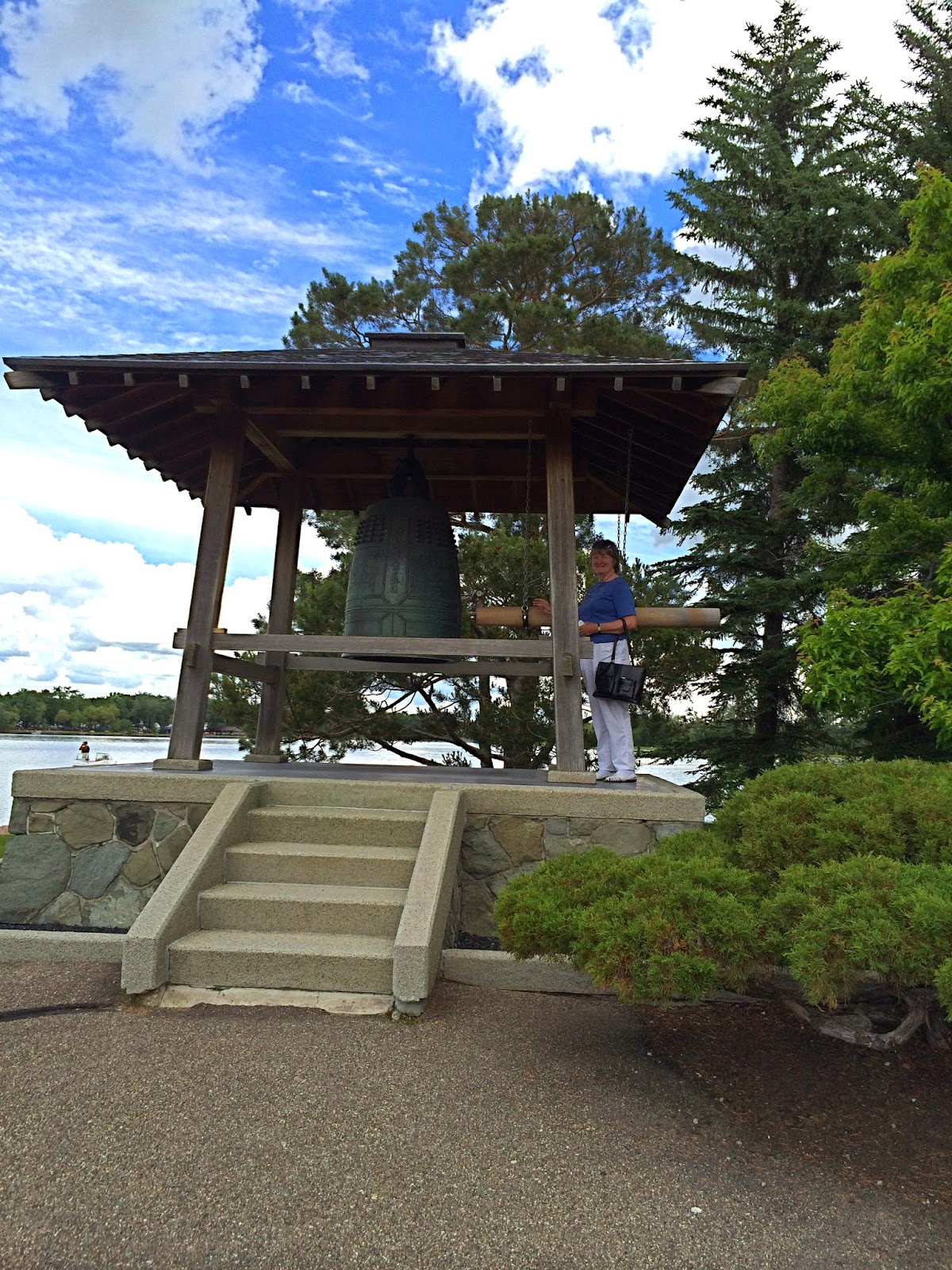
All the structural aspects of the garden including the bell tower (seen below), the bridges, gates, azumaya shelter (gazebo), and pavilion were built in Kyoto Japan "of aromatic wood from yellow cypress", then dismantled and shipped to Canada. From Kyoto, five master tradesmen reassembled the structures on site with the help of some Canadian tradesmen. "The bronze Friendship Bell, which hangs in the bell tower, was commissioned specifically for Nikka Yuko and cast in Kyoto. The bell’s deep tones ring a friendship call to all visitors." (www.nikkoyuko.com)


The Friendship Bell was placed in the garden to symbolize the friendship between Canada and Japan. The idea is that the ringing of the bell, which guests are welcome to do, sends a message of friendship and goodwill. Using the weight of the bell to hold it together, the tower is structured on a compression ring principle.

A borrowed view of Henderson Lake beyond the garden. During the time of my visit, the Dragonboat Festival was underway.


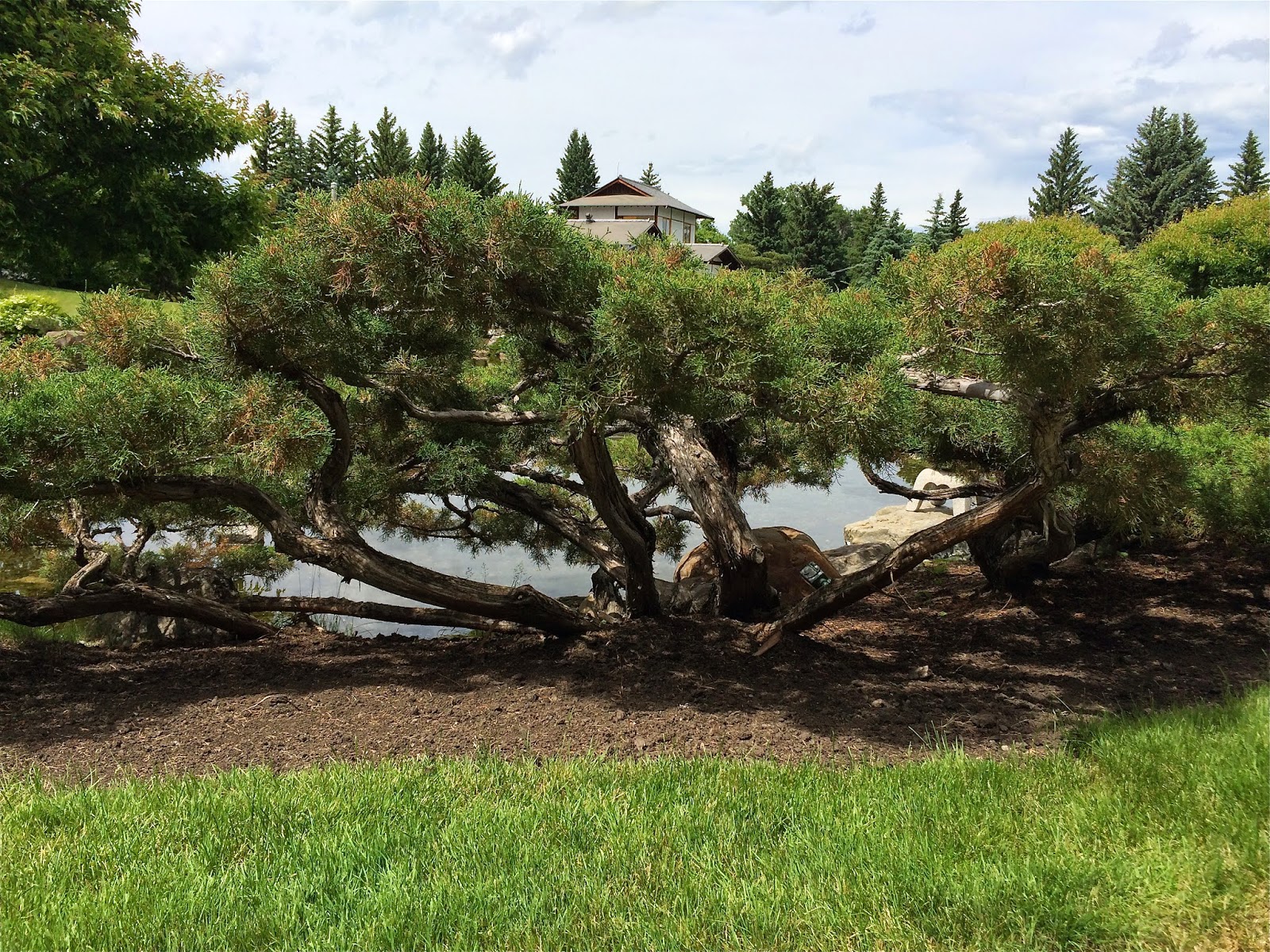
These two photos, above and below, show the emphasis placed upon pruning of evergreens in the garden.


The heart of a Japanese garden is water, which in the Japanese culture symbolizes purity.

The pavilion is built of yellow cypress and cedar. No nails were used in its construction. It was built using 17th century architecture methods.

Evergreens, trees, water and stones are the framework of the garden. They provide the shape throughout the seasons, providing a backdrop for the seasonal blooms. In this instance, the peonies. Other Japanese gardens might use rhododendrons and azaleas where hardy.


The sound of the flow of water in the streams and waterfall is like "music" in the garden.


Inside the Azumaya (you can see a bit of the roof and base in these photos) one can enjoy the scenery of the garden and the borrowed view of Henderson Lake beyond.

Amur maples, in this garden, and Japanese maples, in other gardens where they are hardy; are used for their fine foliage, seasonal colour, summer flowers and seed pods. In winter their bare branches are art unto themselves.


The Scots pines and spruce are planted inside the garden and outside the garden walls to give the impression of a forest.

 |
| Origami display in the tea house |


At the back of the roped off room, one can see an Ikebana or Japanese flower arrangement. The ceremony takes place in the alcove or tokonoma. Note upon the wall in the tea room, the Kakejiku scroll which describes the theme. (see http://japanese-tea-ceremony.net)
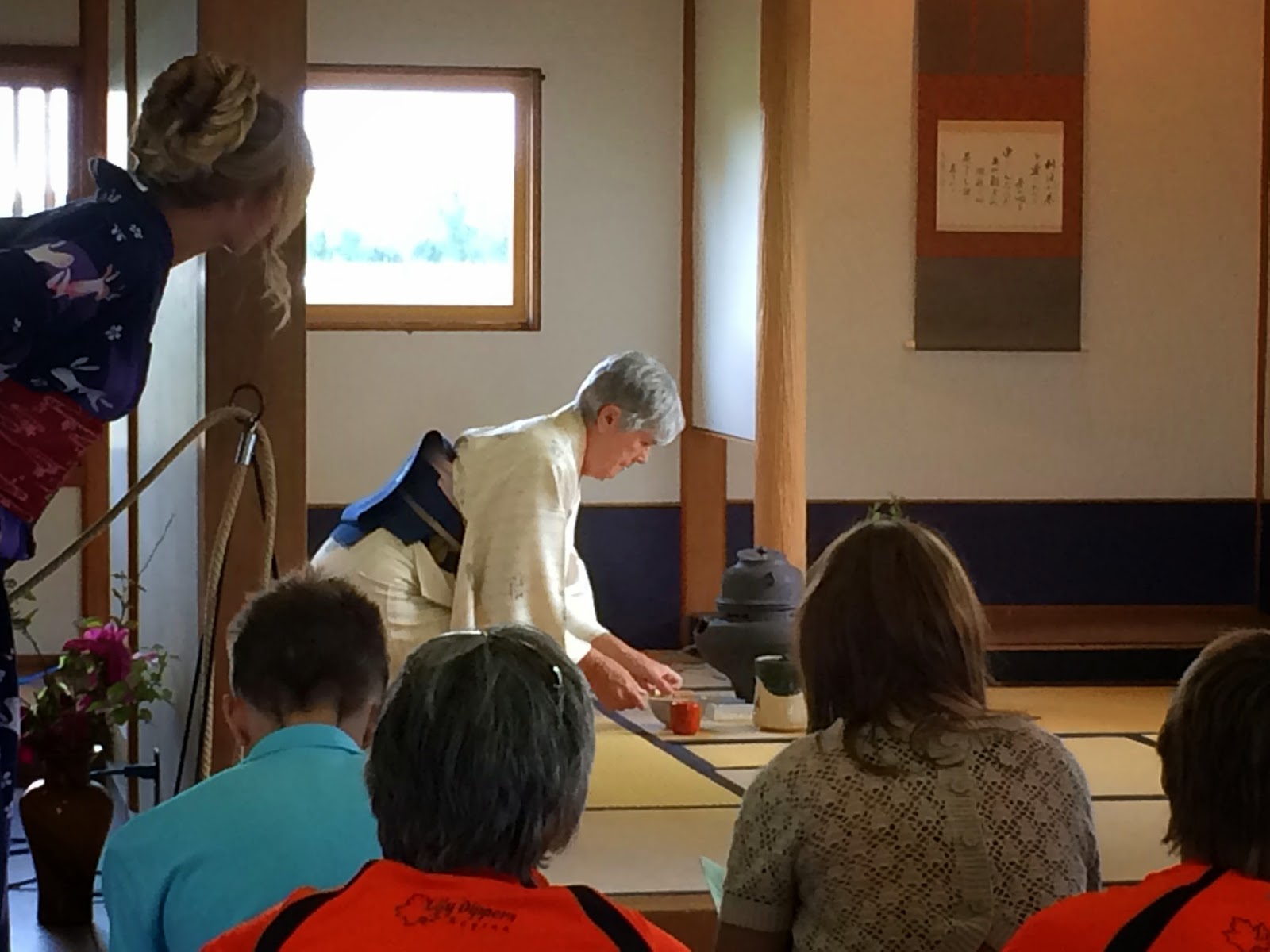
We were fortunate to have arrived at the garden with time to sit for the tea ceremony. The tea is a green tea called Matcha and is prepared with careful attention to detail. It is quite a lengthy ceremony with its origins coming from China. The ceremony is more about the preparation and aesthetics than the drinking of the tea. Note the kimonos and socks.
A brief history was provided before the tea ceremony began wherein four volunteers were given the opportunity to join while the remainder of the visitors sat upon cushions on the floor. The mat upon which the tea ceremony is held is called a tatami.


One of the views through a window in the pavilion.

The landscape is built up to represent a mountain from which this waterfall flows. This photo was taken from the vantage point of the pavilion.

Other deciduous trees used in the "forest" include Russian Olive and crabapple.

The view from within the pavilion.

The dry rock garden is designed in clusters of odd numbers of rocks (3,5,7) which represent islands in the sea. The sand is raked into place around the "islands." There is beauty in this simplicity (wabi). This garden is accessed only through the pavilion. You may open the shoji (sliding doors) to view and kneel on the floor elevated above the dry garden to meditate.


Above and below, from within the pavilion one obtains a different vantage point than from anywhere else in the garden.


A path completely circumnavigates the garden. You may cross the bridges but for the most part, the visitor views the gardens from the perimeter. One is not allowed upon the grass nor on the smooth rock beach which I didn't photograph. Benches are placed strategically for visitors to sit and enjoy.

Rocks are set into the ground, rather than resting on top, thus appearing to have been there forever.

Plants were selected to offer texture and subtle colour. Plant varieties were chosen which closely resemble those used in Japan but would be hardy here. Pines and Amur Maples are used in abundance. A Japanese gardener takes care of the plants, pruning them to accentuate their beauty and grace whether the branches sweep toward the pond surface or reach into the sky.

During our visit a couple young women posed in different costumes for photos.

Evergreen trees are used to indicate permanence.

While we, my mom and I, were there I saw a young man propose to his girlfriend near the pavilion. However, I didn't take photos out of respect for their special moment.
The Nikka Yuko Japanese Garden has a lot to offer. You may stroll the grounds on the pathway; ring the bell; sit and relax on a bench or in the Azumaya (gazebo); participate or view the traditional tea ceremony; take a class on Ikebana (the art of Japanese flower arranging); learn origami (paper folding); take a class; attend a moonlight viewing, which I believe is offered twice a year; or participate in other special events. There is also a gift shop on site, where you purchase your tickets for entrance to the garden.
It has been several years since I last attended the Nikka Yuko Japanese Garden and it was my first tea ceremony. The garden seems smaller than the last time I saw it but perhaps that is because the trees have matured that much more over time and so have I. Comprising 4 acres of land, the Nikka Yuko Japanese Garden remains one of the most beautiful Japanese Gardens I have ever seen.
Visit the official site of the Nikka Yuko Japanese Garden for more information and hours: www.nikkayuko.com
The following site is very informative if you'd like more information about tea ceremonies and everything associated therein: http://japanese-tea-ceremony.net
Subscribe to:
Posts (Atom)
LinkWithin
