21 August 2010

Spotlight - Amur Maple

The tree in this photo is an amur maple shrub trained to tree form

Acer Ginnala - Amur Maple
Can be found in shrub or tree form
Shrub size - 10-15 feet.  Fast grower.  Hardy zone 3.  Deciduous. White scented flowers in the spring followed by samaras (winged seed pods).  Fall colour - Red sometimes yellow/orange depending on the year.  I have noted a warm long fall intensifies the colour.  The shrub can be trained to tree form making a smaller tree.

Tree size - 15-20 feet tall and 15-28 feet wide.  Deciduous.  White scented flowers in the spring followed by samaras.  Tolerates dry soil.  Prefers a well-drained site.  Growth rate is considered slow.  Forms a dense rounded canopy and makes an excellent shade tree.  Fall colour - scarlet red

Amur Maples are an excellent specimen in the urban landscape offering shade and outstanding fall colour.  Often multi-stemmed, the amur maple makes an excellent climbing tree too. 

Along 97 Street in Edmonton, one can see multiple plantings of this tree in the Griesbach area.  Often families will stop by in the fall to take family photos in front of these trees.

Amur maple during the fall (photo taken along 97 street, Edmonton)

20 August 2010

BC Forest Fires Affect Albertans

Seclusion Bay, BC
Firefighters have been fighting forest fires in the interior of British Columbia for some time now and as of Thursday, our province has experienced a deterioration of air quality due to thick smoke.  People within the affected regions of BC, including some of the Okanagan area, have been evacuated. 

Here, in Edmonton, individuals with respiratory problems have been advised to stay indoors with windows closed.  The remaining population has been told to avoid strenuous exercise outdoors during these conditions.  Even Southern Alberta is beginning to feel the affects of the smoke.  I was told as of today, Coaldale and Lethbridge can see the heavy veil of smoke hanging in the air.  Hopefully the air mass will improve this weekend.

Plum Good


Two varieties of plums pictured above and below.  One is a Pembina and the other is unknown.
Photos by Anne M.

We can grow some delicious plums here in Alberta.  One problem we sometimes encounter here in the prairies is the tendency toward chlorosis.  Our soil is very alkaline, making it difficult for some trees to access the iron necessary.  Gardeners may  apply chelated iron to supplement their trees.  Maples can have the same problem.  I've even seen it in roses and peonies!

Plums that are hardy here include:  Brookred, Pembina, Opata, Brookgold, Ptitsen #5

Wild plums, though very difficult to find, like prunus nigrus (Canada Plum) which grows in the states and in some areas of Alberta and Saskatechewan near rivers, and prunus americana (American Plum), are the most successful pollinators of hybrid plums according to the University of Saskatchewan where they've been growing wild plums from seed.  Wild plums tend to flower a bit later and it has been suggested for them to be effective pollinators for early flowering hybrids, the grower should train lower branches to grow near the ground where they will be "fooled" into blooming earlier.  It is essential that pollinators bloom the same time as the chosen hybrid plum. 

Cultivars of prunus salicina, commonly known as the Asian or Japanese plum, bloom early and are good pollinators for eachother.  Sour cherries will not improve pollination of hybrid plums though both are in the prunus family.  Most sour cherries, ie. Nanking, Evans, are self-pollinating.  Sandcherries are good pollinators for cherry-plums like Opata. 

For more information on research on plums for the prairies see this document:
http://www.fruit.usask.ca/articles/plums.pdf

18 August 2010

Independant Garden Centers

I regularly read a blog "Garden Rant - Uprooting the Gardening World" because they are different, controversial, and in the know.  They are gardeners and writers and regularly address items all of us are curious about or have issue with.  They recently did a survey about Independant Garden Centers and I include here a link with the results of the same.  I think every Independant Garden Center should seriously read this survey and I implore them to ask themselves "Am I meeting my customers' needs?"  Check the link below:
http://www.surveymonkey.com/sr.aspx?sm=sdtummV9jy9tMyuan4YcwORwwQsCkN8bfQo6v932sOk_3d

Do you have something to rant about?  Comment here!

17 August 2010

First Place Front Yards in Bloom

Photo by Bruce Edwards, Edmonton Journal

For more information on the selection process and the winning front yard check this link to an article in the Edmonton Journal.

http://www.edmontonjournal.com/life/creek+runs+through+winning+garden/3393050/story.html

2010 Edmonton In Bloom Award Winners

Front Yards in Bloom is a community program recognizing front yards that make Edmonton beautiful.  This year`s winners were awarded by category Thursday, August 12 at City Hall.  The categories are:  Best Edible Front Yard, Best Natural Front Yard, and Best Yard.

Here are photos of the winner, 2nd place, third place and honourable mention in Best Yard category.


First Place - Best Yard

Second Place - Best Yard

Third Place - Best Yard

Honourable Mention

Honourable Mention (my favorite)

Honourable Mention


Best Edible Front Yard

Best Natural Front Yard

2010 Edmonton in Bloom Award Winners (Commercial Categories)

Naturescape recognition: Brightview Elementary School

Tidiness (Litter): HSBC Bank Canada

Tidiness (Graffiti): J. Percy Page High School & Mill Woods Little League

The Wonderful World of Blogging

I love this world of blogging which allows you to "meet" fellow writers and enthusiasts from all over.  Today I had a lovely message from Nancy Bond who welcomed me to the blogging community: 

"Hello from Nova Scotia, and welcome to Blotanical. I've chosen your lovely blog to feature in my sidebar for the coming week or so -- I hope it brings you lots of new readers. And I look forward to exploring your blog further. :)"

Nancy is a writer, photographer and gardener among other things and has produced a lovely and creative blog.  Visit her at:

http://nancybond.wordpress.com/

16 August 2010

Alberta Perennial Trials

http://albertaperennialtrials.wordpress.com/author/albertaperennialtrials/

I just received my newsletter from Alberta Perennial Trials and thought you might want to have a look at what's in bloom in the trial gardens.  Please link back to me as your referral.  Enjoy the sun, folks.

13 August 2010

Attracting Birds to Your Garden

When I worked at the garden center we'd often have customers asking what they can do to attract birds to their yard.  I've noticed an increase in visitors in my own garden over the past few years, in part due to growth of trees and in part due to water features I've added (or have been added thanks to my children).  Of course, setting out feeders, birdhouses and bird baths will draw them too.  There are three basics to keep in mind when wanting to attract birds.  They are food, shelter and water.

Think about the kind of bird you want to attract.  If you like cedar waxwings, plant mountain ash trees.  They are known to come by in winter in flocks, descend upon the mountain ash and devour the berries.  I saw this happen in my own yard just a couple years ago.  It is quite a site!  The following spring we had a pair that seemed to stick around and would visit the pond and trees.
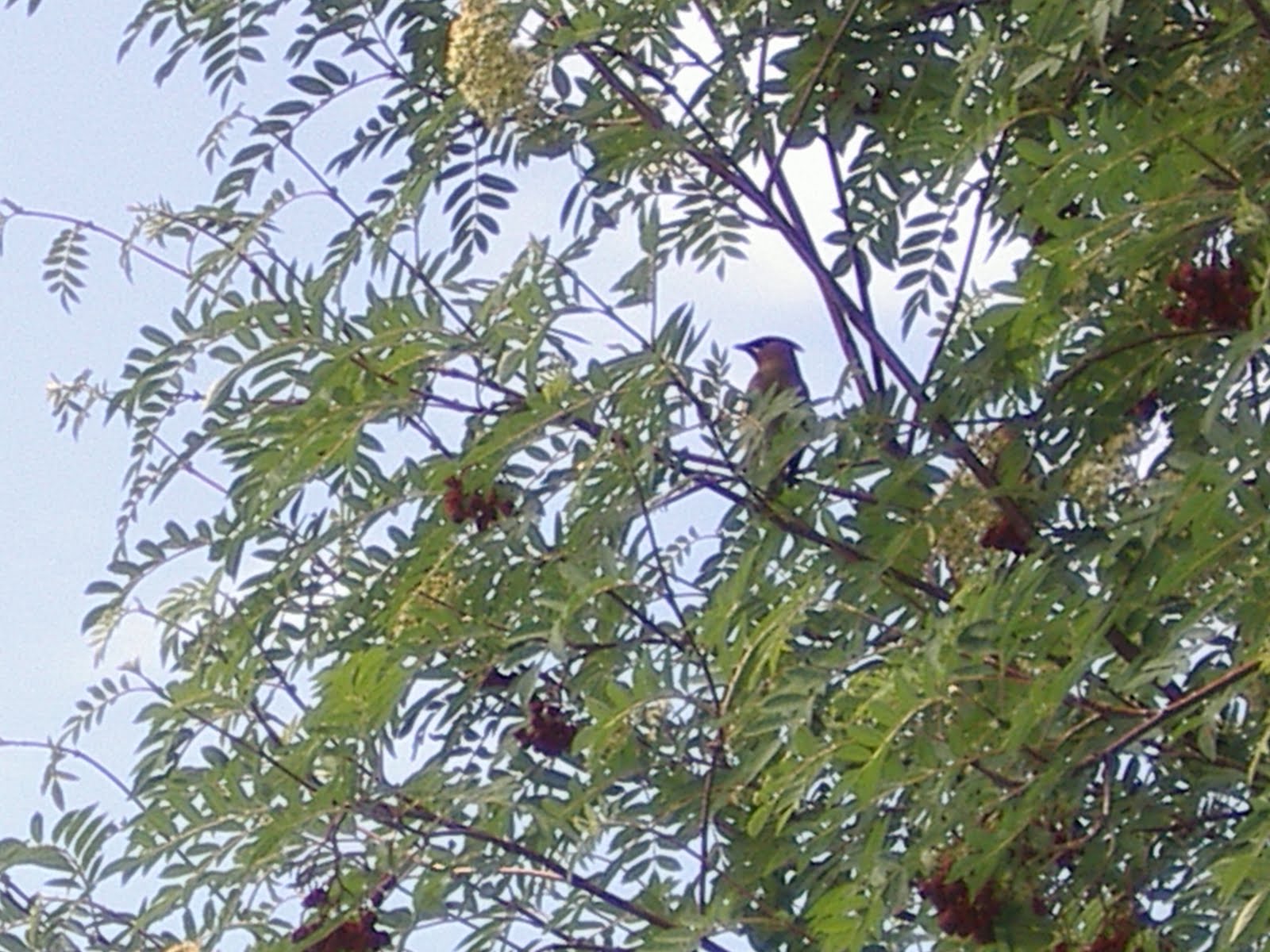
Cedar waxwing in European Mountain Ash tree

If you want to attract chickadees, or sparrows or most other birds, plant trees.  Trees with strong limbs will encourage nesting behaviour.  Although, two years in a row, we had a pair of robins who nested in the supports for our deck.  Sadly a raven discovered the nest and such an upset that was.  The pair moved on to what is hopefully a more secure site.

If you want to attract hummingbirds select flowering plants with tubular shaped blossoms.  One year I had a large hanging petunia planter on our front porch and as I sat there in the cool of the afternoon shade, a hummingbird visited the petunias.  I sat very still, incredibly surprised that they like petunias!  Other flowers to attract hummingbirds include:  azalea and rhododendron, hollyhock, bee balm, fuschia, red columbine, butterfly bush and trumpet vine.  If you have had success attracting hummingbirds with other plants, please comment and let me know.  We do know hummingbirds are attracted to red, thus hummingbird feeders are red or the liquid in the feeder is red.

For more ideas on planting for hummingbirds check this site: 

Blue jays like spruce trees; robins, cedar waxwings and bluebirds like cedars; chickadees and robins like white pine and crab apple; grosbeak and purple finch like maples.  More reason to plant trees in the garden.  Got to love it!   

"If you build it (or plant it), they will come"

For more information and a recipe for syrup for a hummingbird feeder, check my previous post for an excellent article by Canadian Living.


Attract birds and butterflies to your garden - Green Living - Life - Canadian Living

Attract birds and butterflies to your garden - Green Living - Life - Canadian Living

LinkWithin

Related Posts Plugin for WordPress, Blogger...