15 August 2011

Product Trial: Paper Pots Update August 15, 2011

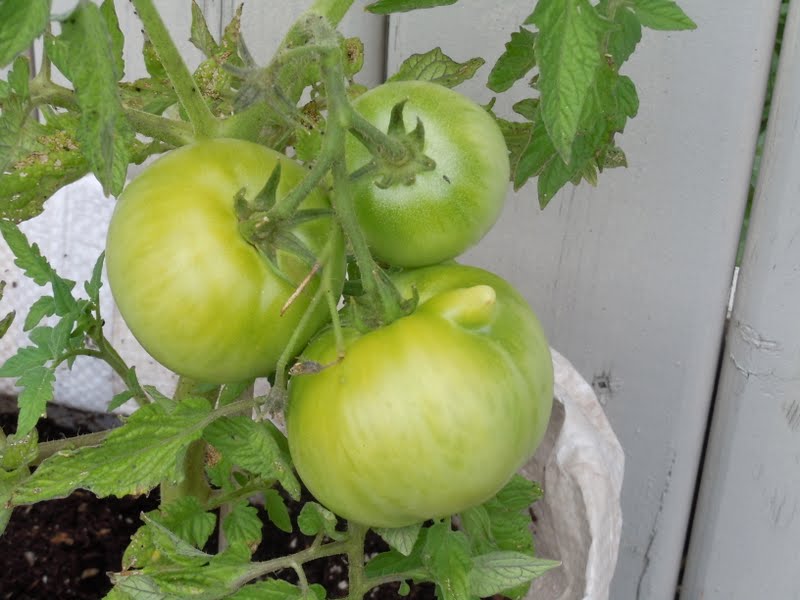
Paper Pot Product Trial planted with Lemon Boy Tomato

The Paper Pot Trial is going fairly well.  Compared to the other tomato plants in nearby containers, its fruit has grown larger faster but the plant seems rather sparse.

Lemon Boy Tomatoes

Lemon Boy is the tomato plant of choice and here you can see it is beginning to ripen.  Last week we finally received summer like temperatures, 24-29 Celsius, and this has been a huge assistance to fruit production and ripening.  I am somewhat disappointed at the number of fruit on this tomato plant and the sparseness of the foliage. 

My fail here is that I had only one Lemon Boy Tomato plant so I cannot compare similar varieties of tomatoes.  Those in the other pots are Roma Tomatoes and they are very bushy with multiple fruits.  Still the trial continues.

If this paper pot is in reusable condition next year, I may try perforating it in a few places for drainage in case we have a wet spring and summer again.  I wonder, though, if that would affect the integrity and stability of the product?

Roma Tomatoes

Note:  all tomato plants received the same fertilizer regimen and were watered the same.

11 August 2011

Sky Watch Friday - August 12, 2011


The Garden


Today I came across this poem given to me several months ago by a dear friend.  
I thought I'd pass it on for you to enjoy too:


For the garden of your daily living, plant three rows of Peas:
Peace of mind
Peace of heart
Peace of soul

Plant four rows of Squash:
Squash gossip
Squash indifference
Squash grumbling
Squash selfishness

Plant four rows of lettuce:
Lettuce be faithful
Lettuce be kind
Lettuce be patient
Lettuce love one another

No garden is without Turnips:
Turnip for meetings
Turnip for service
Turnip to help one another

To conclude our garden we must have Thyme:
Thyme for each other
Thyme for family
Thyme for friends

Water freely with patience and cultivate with love.
There is much fruit in your garden because you reap what you sow.


-author unknown-

10 August 2011

In My Neighbourhood


My neighbour's Endless Summer Hydrangea is blooming.  Our soil is alkaline, here in Edmonton, so the bloom is pink.  Hers is blooming but mine isn't.  Hmmm.  Could be the move last autumn from part-shade to full sun.  Mine didn't bloom last year so I decided it needed more sun.  We'll see.


Near the ravine, several homeowners plant beyond their fences.  Here a homeowner planted pumpkin, I think.  Several others plant flowers or raspberries.


A huge mushroom.  I've seen a lot of these and other fungi this summer.  They love all this rain.


My favourite back yard in the area, above.  This one backs onto the ravine as well.


Another neighbour is growing this pretty little poppy in the front garden.  I like how this photo captures the flower in its different stages of opening.


Liatris is starting to bloom, while the groundcover, Lamium, is complementary in pink.


Dwarf Alberta Spruce in spiral form.  A few neighbours thought this was a good idea this spring.  Not all have fared as well as these, though, turning brown before summer is even done.  I hope they weren't expensive.

The gorgeous maple!!  It is the beginning of August and this pretty tree was already in full finery by the end of July.  Such a beautiful tree!


She loves her flowers!  Look at all these planters!  I'd love to see her back garden!


One of the most beautiful small landscape trees, the Russian Olive, flowers late spring and the scent is divine.  Love the foliage of soft grey/green which hangs on well into the winter.  Look at the furrows in the bark!  This tree's bark darkens over the years, sometimes looking rather charcoal which is a lovely combination with the foliage.


What's blooming in your neighbourhood?  Do you take your camera with you when you walk your dogs?  (like I sometimes do)


09 August 2011

In the Spotlight: Jackmanii Clematis


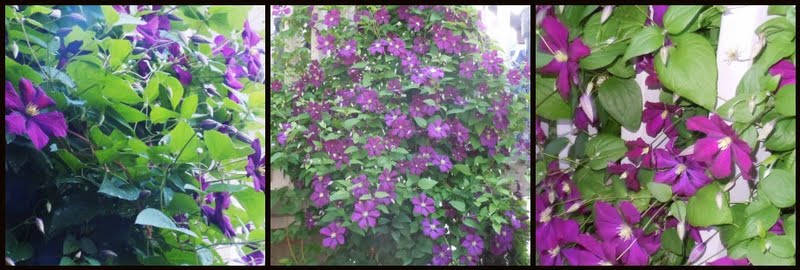
This Jackmanii Clematis is roughly 9 years old and clambers up the side of my deck, facing west.

Description:
The Jackmanii Clematis is a modern hybrid clematis with large showy blooms which can be as large as 5-6 inches across and are a magenta to deep purple.  The Jackmanii clematis was produced by nurseryman George Jackman (1837-1887) of Jackman & Sons, Woking, Surry, and was available on the market in 1862.  

Growing to heights of near 20 feet tall and four feet wide, the Jackmanii Clematis is a superb vine offering masses of purple blooms on healthy twining vines.  A suppport, such as a trellis, is essential for the clematis to climb.  The Jackmanii Clematis requires 6 hours of direct sun a day to achieve optimal blooms.  

Planting:
When selecting your plant, choose one with several vines coming from the root, preferably with the lower portion somewhat woody to ease the transplant process.  Carefully remove from pot and dig a hole about 18 inches deep.  Amend with compost and sprinkle a scant handful of bonemeal in the bottom of the hole and cover this with a bit of soil before adding the vine.  Plant the clematis a foot deeper than it was in the pot so the roots are well shaded and cool.  Fill with good, well-draining soil, amended with compost, gently but firmly tamp down to remove any air pockets, and water.  Gently aid the vines to the trellis so they fan out in a "V" formation.  In two weeks, you may fertilize with a water soluble fertilizer. (See fertilizer below).

It is highly recommended to plant a low growing perennial in front to further shade the roots and keep them cool.  I use irises for this purpose.  In lieu of planting, one may use a large flat rock placed in front to further shade the roots.  A mulch of a couple inches is highly recommended as well.


Fertilizing:
Compost and bonemeal should be added yearly, digging in to just the top couple inches so as not to disturb the roots.  You may also fertilize monthly from early spring until the clematis begins to flower, with a fertilizer designed specifically for clematis and vines or with a general purpose 20-20-20.  Do not fertilize once the vine begins flowering or all the blooms will come at once and the vine will not flower continually until frost.  


Pruning:
Jackmaniii clematis belong to the "C" group, meaning they bloom during summer and autumn and should be hard pruned above second or third set of the buds, 20 - 50 cm (approximately 1 foot) from the ground in late winter or early spring.  I generally wait until I see new growth, then prune back to the second set of buds.
***

Jackmanii is one of the most hardy clematis and a very popular choice with few if any insect problems and rarely any instances of disease.  Clematis wilt is a problem known to affect any variety of clematis and can generally be avoided by planting the clematis deep to keep the roots cool, as indicated above.  Garden sulfur is the recommended treatment.  I found a good article here for further information.

08 August 2011

03 August 2011

The Lure of Evening Scented Stock

I am sitting here on the computer and I know it's time to get off and relax with a book.  But there's a sweet scent on the air, wafting through the open window.  Beckoning me near.....


The evening scented stock (mathiola) is blooming!

Gregoire Lake


My husband just sent me this photo, taken with his phone, of Gregoire Lake, Alberta.  I wonder if there's any sand here?


Wordless Wednesday - Can You Imagine a Sky So Yellow?


This is my contribution to Wordless Wednesday

Can you imagine a sky so yellow?


02 August 2011

Top 10 Gardening Mistakes to Avoid

Photo taken at Greenland Botanic Garden.  A good example of excellent planning, mixing perennials with trees and shrubs for a natural and finished effect.
New and experienced gardeners alike often become over zealous when acquiring plants for their garden. I know I have done it many times.  They just look so good in the store and I know they'll be a great addition to the garden.  But where to put them?  That can be a problem, unless, like me, you  don't mind digging up more and more of the green stuff (lawn, I mean but the other is required for the ambitious gardener too) to make way for the new.  As a gardener, I have high aspirations for my yard.  I know the look I am going for and with a little juggling, it will be accomplished.  But a word to the wise, with a heads up, there are some gardening mistakes you can avoid.
.
Blunder #1: Failure to plan.

Before you rush into the garden centre, make up a plan for your yard.  It doesn't have to be professional and can be done on graph paper.  A plan helps you with the budget as well as helping you avoid the mish mash look that can occur when everything you love is thrown together.  It's best and easiest, when taking on a new project, to break it into smaller accomplishable tasks.  For instance, when we set out to landscape our back yard that was devoid of everything but grass, we started with one bed, which initially was a vegetable garden.  Around the same time, I began working for a local greenhouse/nursery and the aspirations grew from there.  One bed begat another and soon the entire perimeter became beds for trees, shrubs, and perennials.  A pond was added, thus the vegetable garden was bid a fond farewell.  Some aspects of these beds I truly love, probably because some planning went into their design.  But theres' the bed on the west side that needs a do-over in the worst way.  (yes, it was an afterthought.  The catch-all bed for the extras)
This is the bed, in the right portion of the photo, which will be re-designed.
Blunder #2: Buying poor quality tools.

It's true with garden tools, as with anything else.  You get what you pay for.  Having to continually replace tools due to breakage or bending or inability to do a task, is more expensive in the long run and can certainly dampen your gardening spirit.  Buy the best quality tools you can afford.

Blunder #3: Not knowing your soil.

Before you plant, get to know your soil.  Is it clay, sandy, a good loam or rocky?  Unless you have a rich loamy soil, which plants love, you will need to amend it before planting.  Here in Edmonton, we have clay soil.  Fort Saskatchewan, just north east of us, has sandy soil.  Prepare your soil, dig and amend, before you plant.  A good loam is rich in organic matter and doesn't drain too quickly nor does it stay wet for prolonged periods.  Adding compost to your garden soil will enrich the nutrient value, make it more friable, improve drainage and, because it is the ideal medium, helps plants better fight off disease and pests.

Soil tips:
 - Try to avoid walking on the soil, once you have planted.  Compaction of the soil can occur with increased traffic, making it difficult for plants to retrieve the water and nutrients they need and inhibits root growth.  Create paths instead.
-  Don't work a wet soil.  Doing so will result in a clumpy hard-packed soil when it is dry.
-  Don't overwork the soil. The best soil has varied sizes of particles and is not fine and dusty.  The variable sizes aid in drainage.
Shade gardening with ligularia.  Photo taken at Greenland Botanic Garden.
Blunder #4: Planting in the wrong spot.

Take note of the sun and shade in your yard.  Some plants require full sun, 6 hours of direct sunlight, while others prefer part-shade or shade, to grow their best.  Plant according to the sun and shade patterns in your yard.  Keeping in mind that planting on the south side of a house is hotter than the east, so certain plants will perform better there than others.  Do your homework.

Blunder #5: Overcrowding shrubs and trees.

Guilty as charged!  Keep in mind the size in height and width of the tree and shrub before you select its location and plan for these dimensions when planting them together.  Overcrowding is not healthy for the plant (lack of air flow), nor is it appealing to the eye.

A good example of planting in groups.  Taken at Greenland Botanic Garden.
Blunder #6: Scattered plantings - not planting in groups.

Arrange similar plants together.  To have one delphinium here and another in different bed is not appealing.  Try grouping in threes and fives to the best impact.  It is advised to plant in odd numbers for the best visual result.

Blunder #7: Purchasing poor quality plants.

Don't buy just because it's on sale or it's cheaper than other stores.  Cheaper with plants is not always better, particularly if you are new to gardening and are unsure of what attributes to look for when making your selection.  It's best to buy from a reputable garden centre, where the plants are well cared for and the staff are knowledgable.

Note:  You might consider using native plants as they are easier to grow, have fewer disease and pest problems and often require less of the gardener in terms of care and watering.

Blunder #8: Planting Too Deep

Plant container grown plants at the same depth as the surface of the soil in the pot it is growing in.  Planting too deep can lead to root rot and other problems.  The exception to this is clematis which grow best if planted a foot deeper than they are in the pot.

Blunder #9: Over or under watering

Here's a big mistake that many gardeners make.  Depending on the weather and the type of plant, your water needs will vary.  A weekly rainfall of one inch (2.5 cm) is ideal for most plants.  You may use a rain gauge, if in doubt, or try putting a plastic container out to collect the rain.  Measure the depth of the water after the rainfall to determine if you need to adjust your watering.   Other tips:

- Avoid frequent shallow waterings. This encourages the roots to grow shallow, near the surface, instead of reaching deep into the soil for water.  A plant with deep roots better survives a period of drought than one with shallow roots.

- The best time to water your garden is early morning or early evening.

photo taken at Greenland Botanic Garden.  Imagine if this were weedy.
Blunder #10: Being a negligent weeder

It is important to maintain a virtually weed free garden as it eliminates competition for moisture and nutrients, allowing roots of desirable plants to grow at their optimum.  To help keep this task manageable, try spreading a mulch of wood chips or shredded bark around your garden.  This will inhibit weed growth and help to retain soil moisture while maintaining a stable soil temperature.

See also:
Xeriscaping
Planting for Shade
Design Faux Pas and Favourite Tips

LinkWithin

Related Posts Plugin for WordPress, Blogger...