Showing posts with label barberry. Show all posts

13 June 2011

Spotlight on Barberries

Emerald Carousel Barberry in the fall (courtesy of Oregon State University)

There are few plants like a barberry (berberis thunbergi) for colour in the garden.  Barberries were once prohibited for fear they carried rust to wheat.  Berberis thunbergi was developed specifically to be rust resistant and is not a carrier. Relieved gardeners can happily plant barberries once again.

Barberries offer colour all year round.  Early spring, the remants of berries from the previous year may remain on branches still.  Spring, they leaf out in reds, burgundies, yellows or greens.  Near the end of May here in Edmonton, the shrub will flower with the smallest little ball-shaped yellow flower dangled from each branch.  If you don't look close, you will miss them. (see photo above)

Gold Nugget Barberry
During summer they thrive in the heat and full sun.  Barberries prefer a well-drained and somewhat dry soil but you still need to water periodically.  I water once weekly unless it's rained a lot.  Of course, you have to determine your water needs based on location and weather.
Dwarf Gold "aurea nana" barberry

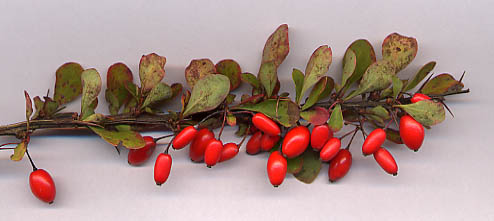
Late summer, early autumn, the barberry produces small red oval shaped berries in place of the flowers.
image from wikipedia

Rose Glow barberries in my front

Some barberries, like Golden Nugget or Sunsation take on red and orange toned leaf colour in the fall.  Emerald Carousel, while green during the growing season, changes to a glowing, iridescent red which is absolutely stunning in the fall! (see upper most photo)

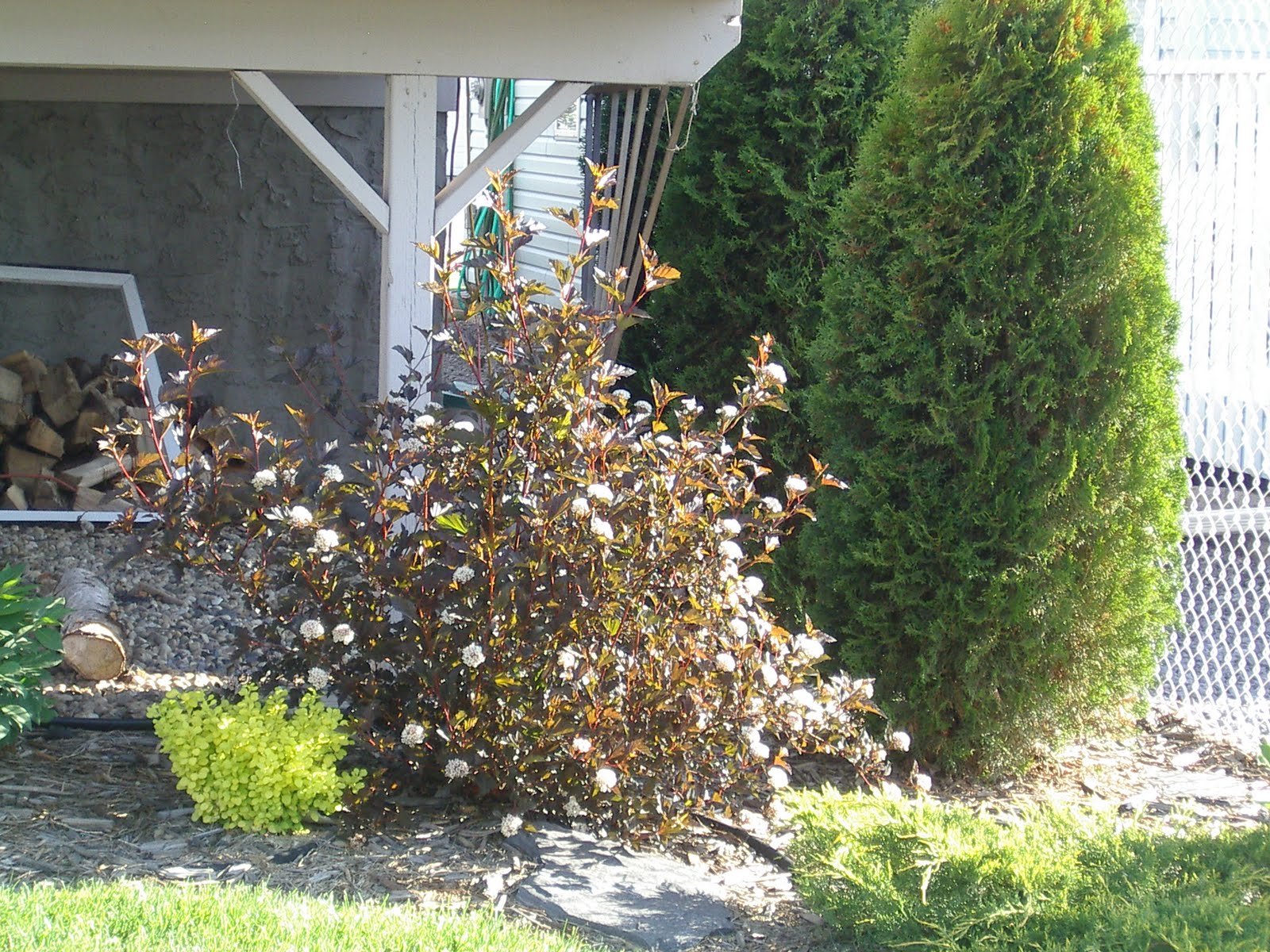
Dwarf Gold "aurea nana" Barberry in the fall next to Summer Wine Ninebark


Care:  Site your barberry in full to part-sun.  Barberries like the Rose-Glow will have best foliage colour when planted in full sun.  After selecting your location in the garden, not in a pot, dig the hole twice the size of the pot, being sure to amend/replace sandy soil or heavy clay with peat moss or a planting mix with peat moss to increase drainage.  Do not use a potting soil with slow release fertilizer as, over time, this will increase the salt in the soil, burning the roots.  (Only use a potting soil with slow-release fertilizer for outdoor seasonal container gardening)

Plant at the same height in the garden as it was in the pot.  Upon filling the hole with soil and tamping it down, gently but firmly to remove air pockets, set the hose nearby and water at a slow trickle until soil is thoroughly moistened to the roots.  Barberries prefer a well-drained site where water will not pool around the roots.  For the first year, you may need to water twice a week until it becomes established.

A general all-purpose fertilizer may be applied early spring.  Barberries are not heavy feeders.  A slight trim in the spring of branches that may have died back in the winter is generally all the pruning that is necessary.  

Older shrubs can be rejuvenated with a pruning to a foot high in late winter.  Be sure to fertilize in the spring to encourage healthy growth.

Berries are edible.

***

Linking up with Mosaic Monday at Little Red House.

*all images are mine unless otherwise stated


10 August 2010

Colour in My Garden

I seem to have a definite lack of colour in the garden this time of year.  Sure I have some colourful foliage in the barberries

Rose Glow Barberry

and the Summer Wine Ninebark

and there's the clematis
Nelly Moser Clematis


Jackmanii Clematis

and this little rush in the pond.

The Pink Diamond Hydrangea blossoms are still white, but gorgeous and the Endless Summer Hydrangea shows no signs of flowering at all!  Perhaps I need to fertilize that more through the growing season so it will mature faster.  Our season has been too short and rainy this year.  Too bad too, because other than some clematis, there's virtually no colour in that bed.  Note to self, I need to mix things up in the east bed!

18 June 2010

Pushing the Limits

We all know someone who likes to push the limits.  They like to see how far they can go without consequences.  However, I am not talking about people in this article.  I am talking about pushing zonal limits.  Did you know that in some cases, plants have not been tried beyond the zone listed on their tag?  Environment Canada began a study a few years back wherein they asked for volunteers throughout the country to try plants of their choice that were rated beyond their zone.  They were to record how the plant fared.  One goal in this was to determine if the zone map for Canada needed to be changed due to climatic changes.

I did not formally take part in this study but I have tried a few plants within my own garden rated a zone 4 and found them successful.  For example, barberry.  I have 3 Rose Glow Barberries (berberis), one Golden Nugget Barberry and another whose tag has long since disappeared but it is a dwarf yellow variety.  All those planted within my back yard do great with very little dieback.  The two Rose Glow Barberries in the front are a bit more exposed to the elements and had more dieback this past winter than the previous three years.  They are recovering quite nicely though.

Endless Summer Hydrangea is a zone 4.  It dies back to the ground for me every year despite mulching and burlapping.  Each year I hope for a long summer so it will have a chance to bloom.  Thank goodness it blooms on new wood as well as old.

Black Lace Elder (sambucus nigra) is another zone 4 in my garden.   It is in a very sheltered location close to the house but it dies back each year.  A quick grower, it regains its height and more in any given year.  Incidentally, this elder has never flowered for me.  Perhaps this is the year.


A neighbour grows a Crimson King Maple (acer platanoides Crimson) in his front yard.  It is fully exposed to all elements and does die back a bit after a bad winter but comes back in full glory.  It is a beautiful variation of maple with large crimson leaves which intensify in the fall.  A Norway Maple, it is absolutely stunning!!


I tried a Japanese Maple overwintered in the garden one year.  It is a zone 5 but no amount of mulch and burlap could save it its first winter.  Don't bother trying to overwinter it in your house.  Powdery mildew is a major obstacle here. 

I had customers who grew Cherry trees with great success.  I am not talking Evans Cherry or North Star (zone 2) which are both hardy here.  I mean a tree similar to the Bing Cherry with sweet fruit.  A lot of labour went into protecting one particular gentleman's tree.  He built a wooden raised bed.  Planted the cherry deep.  And in the fall he cut styrofoam sheets to fit in the bed around the trunk to insulate the roots.  I think he may have even mulched on top of that!  He swears it works!  Part of the key to success here too is watering well into the fall to create a proverbial block of ice around the roots.  This helps irrigate as the ground thaws and assists in protecting the plant from the upheaval of the soil during the freeze and thaw sessions every spring.

Many perennials can be grown successfully in a "lower" zone.  Here you have the advantage of the ease with which you can mulch a bed of perennials.  Water well into the fall too.  I have grown heucheras successfully for years in zone 3 that were rated zone 4.  This last winter I lost a few but have a few seedlings that self-sowed to replace them.  Try Palace Purple Heuchera (coral bell).  


Another is Astilbe.  I've grown Bridal Veil, a white one, rated zone 4, in the shade for at least eight years with success.

You might try the evergrowing variety of Echinacea such as Double Decker, Razzmataz, Harvest Moon or White Swan (all zone 4).  They don't like a heavy clay soil or wet feet.  Supply a well-drained soil and they will respond accordingly.  Especially important, be sure they are not planted where puddles form in the spring as snow melts.  Be courageous, and give a new plant a try.  You just never know.

Have you success stories in pushing zonal boundaries?  Let me know in "comments" please.  I'd love to hear about it!!

LinkWithin

Related Posts Plugin for WordPress, Blogger...