Showing posts with label Frank Ferragine. Show all posts

31 January 2015

Top Four Gardening Trends for 2015

-
Urban agriculture and small space gardening example


  • Urban Agriculture
Grow your own

Small Space Gardening

-vertical gardening
-dwarf plants
-square foot gardening


Fairy Garden


Terrariums and Miniatures

Harry Lauder's Walking Stick


-miniatures i.e. the fairy garden
-terrariums
-bonsais


Unusual and Carefree Plants

-low maintenance
-unusual specimens
Recently Frank Ferragine appeared on Cityline to discuss garden trends for 2015.  This is a brief summary of his ideas combined with my photos.  What do you think of the trends?  Will you be trying any of them?


28 March 2014

Do You Prefer Home-grown Remedies? Then I Have the Book for You!


Natural remedies are nature’s gift to us. From alternatives to side-effect ridden prescriptions to solutions that will amplify the effectiveness of a healthy lifestyle, evolving research suggests that plants may have more power than we could ever have imagined. Now two of Canada’s top authorities in their fields, gardening expert Frankie Flowers and natural healthcare practitioner Bryce Wylde, show readers how they can harness the powerful healing of plants simply and inexpensively by stepping into their garden.

Power Plants introduces you to a carefully curated list of 49 plants that can be grown in almost any Canadian garden. Frankie’s easy instructions lead readers from planting to harvest, where Bryce picks up with clear guidelines on how to put the plants to work fighting everything from constipation to heartburn, high blood sugar to bad breakouts. It even includes simple substitutions for those whose ailments include a thumb that is more black than green. Let Power Plants supercharge your health with a simple trip into your garden.   http://www.amazon.ca/Power-Plants-Simple-Home-Remedies/dp/1443426768


25 February 2014

Are You on Trend if You Plant This Colour?

Image previously shared on Facebook by Frank Ferragine (Frankie Flowers)

“A SEASON OF COLORFUL EQUILIBRIUM Designers take a modern twist on the traditional for spring 2014 by pairing soft pastels with vivid brights to create a colorful equilibrium. Inspired by a mixture of blooming flowers, travels abroad, and strong, confident women, designers use color to refresh, revive and defy conventional wisdom.”  Pantone.com

According to Pantone Colour Institute, these are the colours we will be seeing this spring in fashion, home decor and in the gardens.  Does this help you plan your garden or do you plant what you like best and ignore the trends? Personally, I plant what pleases my eye.


30 March 2013

Trends in the Garden for 2013


As I was watching the gardening special on Cityline, Frank Ferragine (aka Frankie Flowers) shared this new trend in gardening as found at Canada Blooms in Toronto this spring. Since I like to see what's new in the garden world, I thought you'd like to as well.


The colour trend this year for the garden is  green and white, with greens of varying textures and white blossoms and foliage to illuminate the garden.  The collage below is comprised of photos I've taken over the last year or so, all but one of which is from my own garden.

This colour trend is one I've actually loved for years. It offers the serene feeling I longed for in my garden... a place to escape the busyness and stress of the city, right in my own back yard.  Entertaining in the evening is more dramatic too as light reflects off the white foliage and flowers.  For more wow factor, choose plants with large white blossoms like a clematis or night flowering water lily (I tried to find a hardy one for our pond but couldn't), or a shrub/perennial with clusters of white blooms.


 These are just a few examples of what you can do with a monochromatic scheme.  
Visit http://bit.ly/14lCgKn to see the special for yourself.

Other links which may interest you:
http://www.ronaldholbrook.com/images/uploads/pdf/weekend-post1.pdf
http://houseandhome.com/tv/segment/urban-outdoor-oasis
Kingston, Anne. "Instant classic: interior designer Brian Gluckstein teams up with landscape architect Ronald Holbrook to renovate his Toronto garden with trademark sophistication.(city style)."Gardening Life. Canadian Home Publishers. 2004. AccessMyLibrary. 31 Mar. 2013 

16 June 2012

Going Vertical

So many yards, especially within the larger metropolises, have very small yards in which to practice gardening expertise and to enjoy outdoor living.  So, how does one take advantage of what is available to them to incorporate a garden oasis on a small scale?

I was watching a re-run of CityLine today and was pleased to see a favourite gardener, Frank Ferragine (aka Frankie Flowers) doing a segment on this very topic.  From vines to trellises, arbors and pergolas, one can make a small space seem larger by taking advantage of the vertical elements.  Here are a couple of Frank's suggestions:

Left and right, is the tower garden as seen on CityLine. It is an ingenious design where you can plant herbs and lettuce or all ornamentals or a combination thereof.  As the plants grow, the tower is camouflaged.  A real space saver and clever design!


taken at Holes Greenhouses


Along a wall or garden fence, something like this, to the right, can be incorporated to give height and a lush feel to the garden/patio.  You may uses herbs, salad mixes, or ornamentals like grasses, and trailing plants.  Your imagination is the limit here.


This planter/trellis combination, left, would be perfect on a deck or patio for height and privacy.


Behind the fountain is my Jackmanii Clematis growing up the trellis attached to our deck.  In the background you can see three Brandon Cedars which are terrific in a sheltered site for offering year round greenery and height in the garden.


Don't forget to plant trees, provided you have the room!  Trees of varying heights add a vertical perspective and authenticity.  (Yes, this is a garden, no matter how small).  I prefer my garden to have varied levels.  Some tall trees, some mid-size trees and vines, shrubs and low-growing shrubs and perennials.  Doing this offers a more natural feel to the landscape while being pleasing to the eye.  If you look closely, you might see an obelisk, of which there are three in this spot.  I have used obelisks to train peas on, small vines, and now, just as ornaments in the garden.  They, too, offer vertical enhancement.

Vines, such as this bluebird clematis on my neighbour's fence, offer privacy and beauty.

To watch the video segment I enjoyed today, visit: http://www.citytv.com/cityline/garden/article/210151--maximizing-your-small-garden-space


03 June 2012

Frankie Flowers Fast Five: Top Five Plants for Shade

Adapted from the quickest of segments on CityLine, Frankie Flowers (aka Frank Ferragine) spotlighted five plants (perennials) ideal for the shady areas in your garden.  The commentary and photos (unless stated otherwise) here are my own.   "Frankie Flowers' Fast Five Top Five Plants for the Shade" are Heuchera, Helleborus, Hosta, Fern, and Pachysandra.  Read on and you'll see why gardeners everywhere favour these shade lovers.

Heuchera Palace Purple growing in the front bed (above and below)
Flanking this Heuchera on both sides are Shooting Stars (Dodecatheon Meadia) sometimes known as Prairie Pointers.  Behind and to the left is Astilbe.
Heuchera (aka Coral Bells)
How I love this little beauty!  There is such a wide variety of foliage colours and form available but they are all clumping in style.  Ranging form purple as in Palace Purple to deep purple in Obsidian, to marmalade and oranges.  I found Palace Purple does best in shade, turning an unsightly shade of brown in the sun.  Marmalade and other more colourful varieties do fine in sun.  Don't plant this gem in full hot dry sun though, it mustn't be allowed dry out, and it will reward you with the most dazzling foliage.  Its blooms are light airy sprigs that rise high above the foliage, with minute blossoms in white or pink scattered along the stems.


Lenten Rose Helleborus
The Lenten Rose/Helleborus flowers early spring in most areas.  In zone 3, though, it may flower later in the season due to late springs here.  It has a lovely nodding bloom, generally facing downwards, varying in colour from monochromatic to rose coloured.  A pretty little thing, it is poisonous to pets and people. (this photo is stock photo from the internet) 

Hostas along the side of my house.  They love it in this location.  The hostas nearest is Francie.
Hostas
There are so many varieties of hosta available, with new introductions hitting the market each year.  One may select from solid greens and blues (shade only for these), to variegated forms.  I have several variegated forms growing at the side of the house, seen above, and two varieties (Francie and Frances Williams) growing in the bed at the front of the house.  In the back garden, facing east, I am growing two newer introductions which are pale green with a white edge.  These do fine in shade/part sun and will flower with long shoots of lavender or white blossoms.  Hostas are grown for their foliage, though, with many people removing the flowers as they are not so dramatic. The only problem one may encounter is slugs. You may combat this using diatomaceous earth which has minuscule granules of glass mixed in.  It won't hurt pets nor children, but slugs hate it.

Ostrich fern.  Also in this bed are astilbe (left of fern), Hostas, Dwarf Alberta Spruce, and not seen in this photo are Shooting Stars, and Heucheras,  Palace Purple and Plum Pudding.
Fern
There are several varieties of fern available on the market including the ostrich fern (aka fiddle-head fern), shown above.  I've also tried the Arctic fern, and it overwintered fine for a few years and then didn't show up last year at all.  Lady fern is a nice alternative for zone 3 gardens.  It grows 24-36 inches tall, compared to the eventual perspective height of ostrich fern of 3-4 feet.  Ferns like a moist soil and do well in shade.  Some will tolerate a bit of sun if the soil is kept very moist.  The ostrich fern is otherwise known as a fiddle-head fern.  When young the shoots are spiralled as they emerge and it is this spiral form of the fern that may be steamed and eaten.  
http://www.ijsselstein.groei.nl/index.php?id=25317
Pachysandra terminalus
Pachysandra forms a dense spreading ground cover which is ideal under trees where nothing seems to grow.  It has glossy green leaves with small white flowers.  Be sure to keep this plant in check though as it is a spreader.

These are five suggested plants for the shade garden.  I really wish I had more shade in mine as I just love the variety of plants that love the shade.  After visiting Shuswap Lake in British Columbia, and hiking through the most gorgeous lush forests, I endeavoured to mimic some of the feel of the forested undergrowth in my shade garden.  I've included Dwarf Alberta Spruce, astilbe (I love the fine teethed edged varieties), shooting stars, heuchera, ostrich ferns and hostas.  Really, only the astilbe and the ferns resemble the forest undergrowth but the other plants just look so good together and I love them all.  If only it were a larger area....

Have you mimicked a garden or natural habitat in your own garden?  I'd love to know how you did it and what plants you incorporated and/or substituted to achieve the effect.


Til next time, good gardening everyone!


10 March 2012

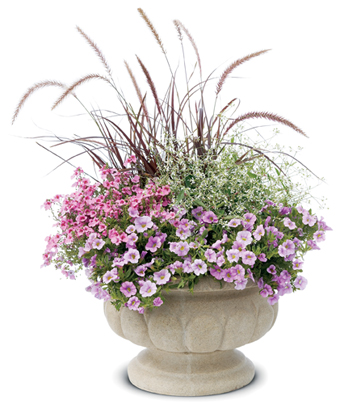
Thriller, Filler, Spiller


http://www.portlandnursery.com/plants/container-gardens/images/thriller-diagram495.png

Thriller, Filler, Spiller is a concept Frankie Flowers, aka Frank Ferragine, endorses when he advises on planting containers.  The above diagram, from Portland Nursery's site, demonstrates the concept. 

First, start with your thriller.  The thriller is the focal point and is usually tall and/or very colourful.  Used here is a dracaena but any grasses, millet, etc. will suffice.  The more stunning in formation and colour, the better.  Remember this is your thriller.

Secondly, select your fillers.  These are mid-level fill ins.  Something somewhat busy but lower growing, but not sprawling or trailing.  Depending on the light and wind, these could be begonias, marigolds, osteospermum, fuchsias, pansies, etc.  Go traditional or original, the choices are limitless.

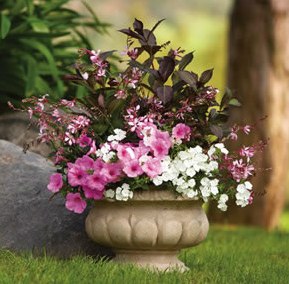
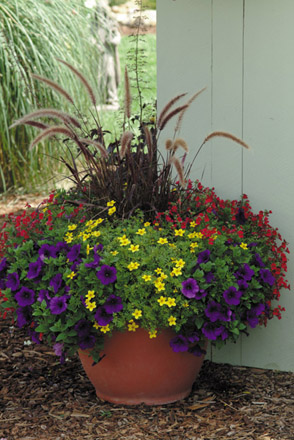
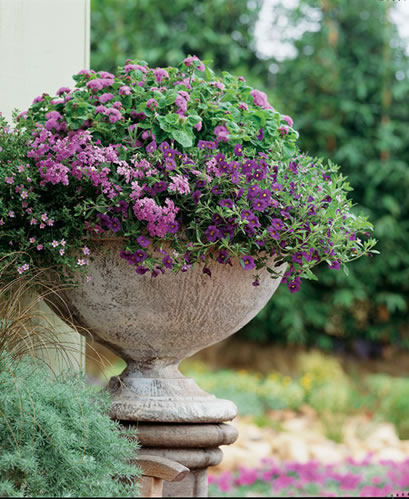
Third, fill in around the edge of the container with your spillers.  These are trailing plants that soften the overall appearance of the container, flowing over and beyond the container, anchoring it to the garden or surrounding area.  I love to use sweet potato vine, but try bacopa, ivy, trailing osteospermum, trailing geranium, bamboo, licorice vine, etc.  Use complementary colours and textures to your advantage to make a stunning arrangement.  Here are some more photos for inspiration:


Proven Winners


09 March 2012

Hot Pot: Talking Container Gardening With Frankie Flowers

No room for a garden but you still want to grow a little something?  Check out this article!  Frank Ferragine (aka Frankie Flowers) talks container gardening.  He also has a new book out, Pot It Up!


17 February 2012

Top 5 Garden Trends for 2012


According to Frankie Flowers (I know, this is a bit of a theme here tonight!), aka Frank Ferragine, the top five garden trends for 2012 are:

1.  Grow your own.  More and more people are getting back into vegetable gardening!  North America's movement to live local, which means eating locally grown foods as much as possible, combined with the influence of celebrity chefs, has been a huge encouragement towards growing your own.

2.  Community Gardens.  More communities are providing designated growing spaces for urbanites who might be short on room but are wanting to adopt/rent a spot to grow their own vegetables, etc.

3.  No space - no problem.  With limited space in big cities and more and more people moving into apartments and condos, space is limited for growing.  Thus the trend towards more container gardening (see Frankie's new book Pot it Up) and growing vertically.

4.  Outdoor Living.  This is not a new trend by any stretch but it is becoming more and more popular.  This year will see more people not only gardening, but entertaining and relaxing in their own little oasis right in their yard.

5.  Inner Gardening.  The urban jungle, all the concrete high-rises and office buildings, is an enormous influence in this trend.  More and more people are looking for a touch of the outdoors that they can enjoy inside.  Easy plants and indoor growing solutions are at the top of this trend.

http://www.frankieflowers.com/frankies-blog/frankies-top-5-garden-trends-2012/

05 April 2011

Gardening Book: Get Growing by Frank Ferragine

Get Growing
Author:  Frank Ferragine (aka Frankie Flowers)
Available February 2011 at local bookstores, Costco,
Shop Online at: Amazon.com, Indigo
http://browseinside.harpercollins.ca/index.aspx?isbn13=9781554688333&utm_source=news&utm_medium=eml&utm_content=harperpop&utm_campaign=040511

Book Description:


"Have you ever looked enviously at a neighbour’s garden and wished you had a green thumb? Have you ever gone to the garden centre full of enthusiasm, only to find yourself confused and defeated? Have you ever wished that somehow gardening could just be, well, easy? If so, it’s time to Get Growing with Frankie Flowers. In 352 pages packed with inspiring yet instructional photos, Frankie coaches gardeners of all levels through the basics of getting a garden growing. Broken down into seasonal chapters that give the reader concise, clear instructions on what you need to do now and why, it provides a solid foundation for building a beautiful ornamental garden, a healthy, natural lawn and a bountiful vegetable garden. With tons of step-by-step detail—in words and photos -- this book includes everything from planning and planting to pruning and fine tuning. It’ll also help gardeners of all levels troubleshoot problems like weeds and slugs and rodents (oh my!). Gardening shouldn’t be complicated or overwhelming -- it should be fun. The secret is just to get outside and Get Growing!"


02 April 2011

Design Faux Pas and Favourite Tips

Design Disasters!
  • One season interest.  Plan your garden for year round interest.  Spring bulbs, forsythia, double flowering plum, bridal wreath spirea, rhododendrons and azaleas are all good examples of plants to include for spring colour.  Summer colour might include Schubert chokecherry (flowers and leaf colour), summer flowering bulbs such as dahlias or calla lilies, clematis, honeysuckle, mock orange, viburnum and more add colour to the summer garden.  Fall colour is often overlooked when planning for the garden.  Try maples, dwarf burning bush, barberries, spirea and more offer great leaf colour while mums brighten the garden with vibrant colour.  Winter interest is often forgotten.  Here are some ways to keep the garden interesting during the long cold winters.  Add evergreens, grasses like miscanthus, plants with unique branching like Harry Lauder's Walking Stick, trees with colourful bark or interesting texture like European mountain ash, Amur chokecherry, Russian Olive, maples and more.
  • It's just too much.  The gardens that are overflowing with statuary, or overgrown plants, or overplanting.  Too much of a good thing is still too much.
  • Scale.  Plant to scale.  Don't use diminutive plants in a foundation planting for a two-story house or towering trees in front of a small home.  For planters remember the rule:  Height of plants should be 1 1/2 to 2 times the height of the container for correct visual balance.
  • The Christmas tree.  The new homeowner decides he/she wants an evergreen right out front that they can decorate with lights for Christmas every year.  Initially this looks fine but over the years the tree outgrows its site, dwarfing the house behind it.  See above photo.  Remember, selecting a plant today can impact you in the future.


Sissinghurst White Garden - note how the white pops in the shade but washes out in the sun.

Frank Ferragine's Favourite Tips:
  • Sunny days are the worst garden days.  It's so much harder on the plant to plant it on a sunny hot day.  Wait for a cooler overcast day to plant and your garden will thank you.
  • Prune after blooming.  Prune lilacs after they bloom.  Same goes for any flowering shrubs.  Deadhead annuals and perennials (unless you plan to save seeds) to encourage flower formation.
  • Weed after it rains.  Have you ever tried to pull weeds when the soil is dry?  It's not an easy task.  Wait until after it rains, or after watering, and you will find they come out so much easier.
  • Fertilize after watering.  This allows the fertilizer to be absorbed more readily.  Frank's favourite is still water-soluble 20-20-20 diluted at half-strength applied weekly.
  • Soap in the fingernails.  After gardening, when your nails are dirty, run your nails over a bar of soap.  You will find it easier to remove the dirt embedded there.  Wash your hands in cold water after gardening as it removes dirt easier.
  • Weight tall garden containers to prevent blowing over in the wind.  Place something heavy in the very bottom and then add soil.
  • Correct height for plants in a container is 1 1/2 to 2 times the overall height of the container.
  • Small properties look best planted with pastel flowers as it makes the area appear larger.  Large properties look great planted in a vibrant colour palette.
  • Plant colourful flowers in full sun and white and pastel colours in shady areas.  White washes out easily in the sun while bright colours remain vibrant.  Light colours make shady areas pop.
  • When transplanting flowers from the pot to the garden, pinch any flowers and remove them (ie. marigolds).  This may seem cruel but the plant will establish itself faster and easier and reward you with more abundant flowers later.

01 April 2011

Garden Trends 2011

I was watching Cityline the other day, well actually it was like 3am and I was awake, TV on, and Frank Ferragine was on talking about the garden trends for 2011.  Looks like a good idea for a post, I thought, so I quickly grabbed my scribbler, which sits by my bedside, to record it all.  Some of these were discussed at the workshop I attended at the Home and Garden Show here in Edmonton too.

Vegetable Gardening.
If we had told our grandparents years ago that vegetable gardening was going to be a trend in 2011, I am sure they would have laughed at us.  Not a trend, they would have said, but a means to an end...a necessity.  It was for many.  It wasn't that long ago that vegetable gardens were the norm but now it is a trend.  Go figure!  Vegetable gardening is taking on a new look too.  Raised beds (like BUFCO below), designs including flowers or including colourful vegetables in the flower bed are on the rise.  Imagine a colourful kale, purple cauliflower, swiss chard, amongst your flowers.

BUFCO debuted at  Canada Blooms 2011.The BUFCO Raised-Raised Bed, made from eastern white cedar logs, features hip-high (3 feet tall) gardening. The growing area is large enough to accommodate a good variety of vegetables and holds up to 10 inches of soil. The pedestal of red cedar can hold lots of storage for your gardening tools and supplies. http://bufco.ca/index.php/products-a-services/the-bufco-raised-raised-bed.html


Great for balconies, decks and patios, the Raised Raised Bed can be a  productive food producer while making gardening accessible for those in wheelchairs or for those who don't like to bend while gardening.  A real back saver.


Purple/Black Foliage, Grasses and Flowers
Purple and black will be all the rage this season as gardeners look for something original to plant in their beds and containers.  Think Black Velvet Petunia, purple carrots, Black Mondo Grass, Pennisetum Purpureum Prince Purple Fountain Grass- in a black/purple colour, Pennisetum Glaucum Purple Majesty, Pennisetum Glaucum Purple Baron, Pinstripe Petunia, Black Dragon Coleus, Calibrachoa Blackberry Punch (Superbells),  Coleus Chocolate Mint.
Gnomes
Seriously?!  Thanks in part to the new release of "Gnomeo and Juliet", garden gnomes statuary is a growing trend for 2011.  Gnome sales have increased 20% since this movie came out.  Personally I don't like statuary/accessories of this type, preferring fountains, wrought iron, and such.  Doesn't everybody's grandma have these hidden in their gardens?


Black and White Colour Schemes
White is great in the night garden but don't put it in full sun as it will appear faded and washed out rather than the accent you desire.  A shade garden is perfect for those punches of white too.  Imagine, if you will, a planter that receives shade in the hottest part of the day planted with "Prince" pennisetum purpeum in the center, chocolate mint coleus, white impatiens, and a lime green sweet potato vine, or three if you have a large container, perhaps a trailing aparagus vine. One could go with a dark colour scheme and accent with lime green or white to achieve this effect.  Pump up the colour!  Consider grouping planters together where each planter focuses on a different aspect of the black and white scheme.  One could be dark accented with lime green, another light colours accented with dark.  Use your imagination and make it your own.

Incorporate Nature
Bring in bird feeders and water features to attract birds to your garden.  Plant flowers that butterflies love such as bee balm (monarda), columbine, hollyhock, butterfly bush (hardy to zone 5, mostly).  Plant flowering shrubs that will attract hummingbirds such as rhododendron (if it will flower in your area when hummingbirds migrate there) or weigela, and flowers such as petunias, calibrachoa, trumpet vine.  Hummingbirds are partial to red.

These are the top five gardening trends as mentioned by Frank Ferragine on Cityline. Have fun with something new this year and remember to Punch Up the Colour!

30 March 2011

Gardening Tips From Frank Ferragine

Yesterday's post contained notes from Frank Ferragine's workshop "Gardening 101" as presented at Edmonton Home and Garden Show.  Today I am focusing on Frank's tips - ideas to fulfill the goals and ideals discussed in his "Gardening 101" workshop.  Some of this information is supplemented with hardiness maps and related information that I researched for this post.

Know Your Soil

  1. To roughly determine the composition of your soil without sending it off to a soil analysis expert you might try this.  Go to the middle of your garden plot and remove enough soil to fill a mason jar 3/4 full with soil.  Next add water and dishwashing liquid.  Shake.  Allow to sit at least overnight.  You will find the soil will have separated into layers. You might see sand, loam, clay in the jar.  This will give you an idea of what types of soil amendments you should consider to make the best of your garden plot. 
  2. Amend your soil in the fall.  Why?  The freeze and thaw cycle through fall, winter and early spring will work in the amendments and loosen your soil to make it easier in the spring to finish the amendment in preparation for planting.
  3. If you get manure from a friend who is a farmer, get aged manure and ask that it be dug out from the center of the pile.  The center of the pile heats a great deal thus killing any weed seeds that may be present.  Also, Frank likes to use sheep manure as it has fewer weed seeds to begin with.  There's something about the sheep's digestive system that makes it so.
  4. Frank loves to plant in raised beds.  He has tried and currently uses 4' x 8' boxes constructed from plywood.  Don't use pressure treated lumber nor treated railway ties as toxins in these woods will leach into the soil and, subsequently, your vegetables growing there.
Know your location. 
  1. Frank says the higher the elevation, the lower the zone.  For example, a balcony on a high rise, say 14 floors up, will be a lower zone than the ground floor.  The ground floor might be a zone 3 but the balcony 14 floors up will likely be lower, zone 2 for example.  Interesting.  The closer you are to sea level, the milder the climate, thus the higher number zone.  ie.  Vancouver is zone 8, Edmonton is zone 3b.
  2. http://www.usna.usda.gov/Hardzone/ushzmap.html
  3. Canada's hardiness map zones and USA's hardiness map zones are different.  According to the  USDA Edmonton is zone 3b while the Canadian hardiness map indicates it is zone 3a.  The USDA hardiness zones are informative: the extremes of winter cold are a major determinant of whether a plant species can be cultivated outdoors at a particular location.  Canada's map takes into account other variables such as median highs and moisture. 
For more information see plant variables.


Most plant labels are printed in the states, thus they indicate the USDA zones rather than Environment Canada's zones and the information comes from the US.  The gardener needs to be aware of the differences. 

Check this comparison model and find your particular zone to make proper selections.

Micro-climates
Many gardens have micro-climates.  Take note where the snow melts first in your garden.  This is a warmer micro-climate.  Consider planting crocus in that spot for early bloom.  Frank plants crocus bulbs right in his lawn.  Once the bulbs quit blooming the grass is growing and all can be mowed as you mow the lawn.  At least that is what he has done and has mesmerized neighbours and visitors alike when they see the crocus blooming in what was and will be the lawn!

In these micro-climates, you can plant, experimentally, those less hardy perennials and shrubs.  I have a micro-climate near my deck where I grow a rhododendron (zone 4) and it seems perfectly happy there.  Try experimenting with hydrangeas, magnolia shrubs, perennials and such.  It is advised to try only one zone above yours for best results.  In Edmonton (zone 3a/b) I have not had success with any zone 5 plants.  That being said, Lois Hole said many plants that indicate one zone do so simply because they weren't tried in a lower zone.  She was a big proponent of experimenting with zones in her own garden. 

Tomorrow's post will include some design disasters, Frankie's favourite tips, and some little tidbit factoids.  Come back to green up your figurative green thumb!

Gardening 101 With Frank Ferragine (Edmonton Home and Garden Show)

The Realities
  1. There are no no-maintenance gardens.
  2. Some plants will die.
  3. Gardening is not rocket science.
  4. Gardening is trial and error.
Ultimate Goals
  1. All year interest.  Include evergreens, grasses, weeping trees and statuary/hard structure.
  2. Your garden needs to fit you and your lifestyle.
  3. Find the right plant for the right place.
The Keys
  1. Know your soil. ie. clay, sand, loam
  2. Know your light. ie. full sun, part sun, shade
  3. Know your zone ie. USDA/Canada zone, microclimates
  4. Know your limits ie. slopes, winds, high traffic, children, pets, your physical limits
Next post goes into more detail in the above.  Be sure to stop by tomorrow.

26 March 2011

Meeting Frank Ferragine

Yesterday I attended the Home and Garden Show and got to meet Frank Ferragine!!  Before he did his presentation, my daughter and I were in the area and he came out and greeted us.  We talked about weather and gardening a bit before the show.   He is just as charming and funny as on tv!   Sad thing, my batteries for my camera were dead and I didn't get a photo with Frank.  I had to go to the mall and buy some more.  Oh well, I did get some good photos at the show and will post them later.

I wonder if the coordinators ever attended Canada Blooms?  If not, they should.  The Home and Garden Show here seems more like the renovation show!  Very little to do with gardening.  Kudos to the Nait landscape architecture students who made a stunning garden display complete with flowering shrubs, pathways, and a little patio area.  It was the best thing there!!

24 March 2011

Healthy Bottom, Healthy Top

This morning on the local edition of Breakfast Television (btedmonton.ca) Frank Ferragine (a.k.a. Frankie Flowers), a Canadian gardening expert, put in a guest appearance, the focus being flowers, of course.  Among the topics discussed were sowing seeds now for spring planting.  Frank mentioned that in Edmonton, Environment Canada says our last expected day of frost is May 8.  But we all know how Edmonton can be and Frank reiterated what is common knowledge here.  We can get snow until the end of May sometimes.  I know!  It sucks, really!

Good advice from Frank:  if you are a family of four, don't plant a whole tray of tomato seeds!  Plant what you will eat!  One plant can yield several tomatoes, depending on the variety.  Also, if you don't have room or proper lighting, don't sow seeds indoors.  Rather, buy started plants at the beginning of the season.

Which brings us to "healthy bottom, healthy top."  When selecting your plants, whether flowers or vegetables, check the roots!  Gently pull the plant from the pot and inspect the roots.  The roots should be visible and plenty.  Fleshy white roots indicate good health.  Brown mushy roots indicate root rot.  Smell is also a good indicator.  If the soil and roots smell foul, don't purchase the plant.

For more of Frank's insight into gardening, check out the Edmonton Home and Garden Show where he will put in guest appearances today at 5 and 7pm and tomorrow at 1pm.  More information below:

Frank's new book Get Growing hit store shelves Feb. 15, 2011.  (I saw it in Costco)

Frankie Flowers reaches over 1 million Canadians each week as the gardening expert for BTToronto, CityLine and City TV News, and also writes a column for Canadian Living. His family business, Bradford Greenhouses, is one of Canadas largest combined greenhouse/garden businesses. He lives with his family in Innisfil, Ontario.


Frankie @ Edmonton Home & Garden Show

Greenland Garden Stage
Thursday, March 24 -Opening Night Party
5:00pm & 7:00pm

Friday, March 25
1:00pm

Home & Garden Show scheduling and other information can be checked online at: http://www.edmontonhomeshow.com/

Frankie's personal website is: http://www.frankieflowers.com/

See my previous post about the Edmonton Home And Garden Show for more information about this must attend event!

LinkWithin

Related Posts Plugin for WordPress, Blogger...